Cash flow and liquidity planning (2)
| Blog 2 of 2 | 3 minutes read | The
In times of increasing uncertainty, it is vital to have information related to future cash and liquidity fast and accurately available. No company can survive or grow without profit, but it can also not survive if it isn’t able to pay its debts on time. This is exactly what a liquidity and cash flow plan tells.
To effectively incorporate liquidity planning and cash flow planning is challenging for most companies. Although technology has made major improvements to collect, collaborate and analyse data, the increased financial complexity, regulatory requirements, globalisation, and challenges in integrating data models and processes have significantly increased the complexity for implementing effective liquidity or cash flow reporting processes.
In this blog, we will describe what liquidity and cash flow plans are and how we can help you to implement these plans in your organisation. In our following blogs, we will focus on business benefits and the added value of liquidity and cash flow planning and present examples of liquidity and cash flow planning with proven technologies.
Depending on the type of industry and the way you have organised your operations, financial plans require different granularity levels. Planning horizons and frequencies for creating plans may differ.
However, every organisation should ensure that its planning process provides visibility into two essential areas:
To realise the above-mentioned visibility and for the sake of clarity, we use the following definitions. Overall, the following plan horizons can be defined:
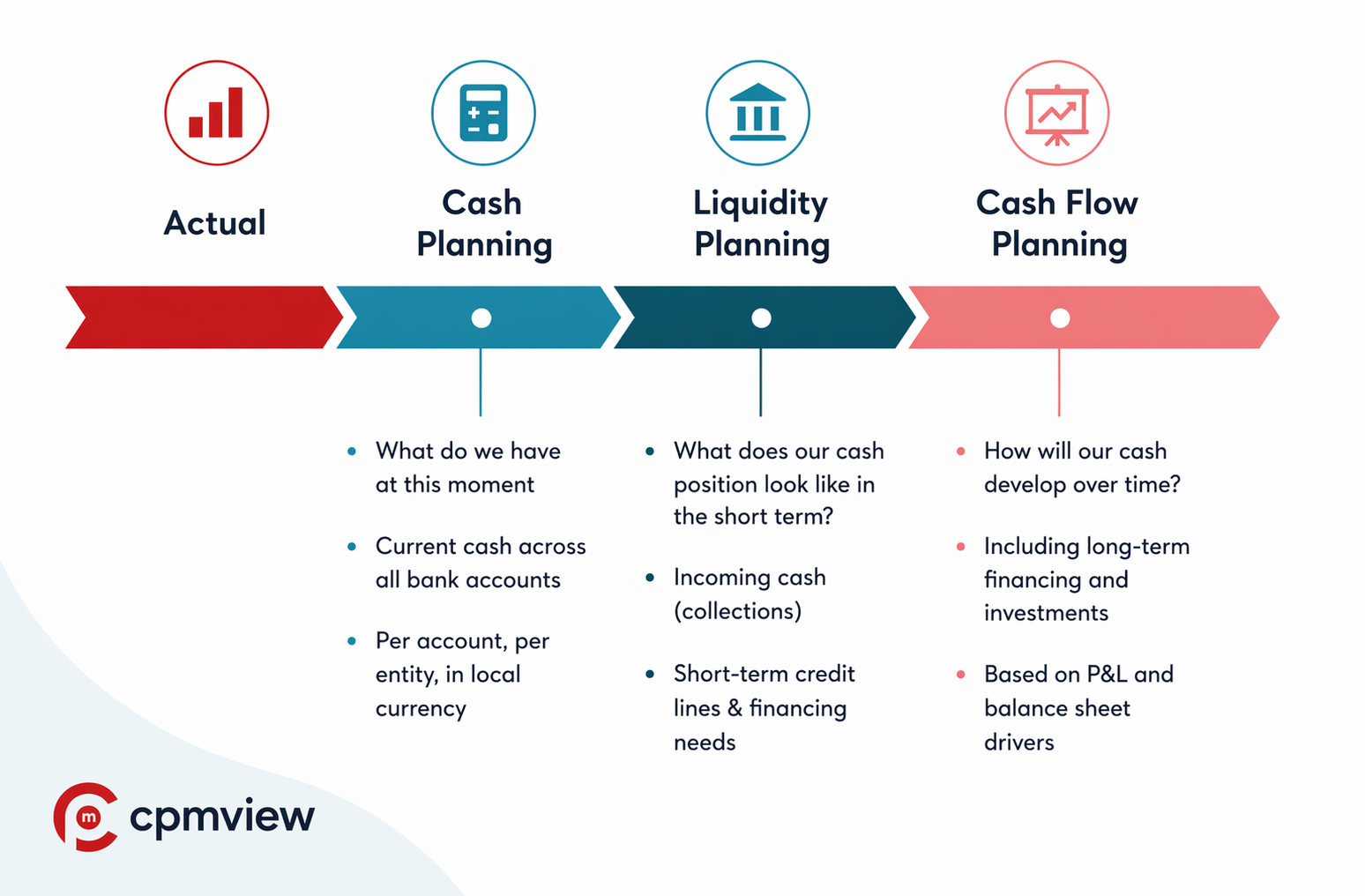
A cash plan is the current amount of cash in bank accounts. Reports show the cash position from operations by bank account, in local currency and per company. The available amount of cash is the starting point for the liquidity plan. In this plan, the focus is to collect cash and plan for committed and uncommitted short-term credit and financing facilities. When you also consider long-term financing and investment activities, you can derive a cash flow planning. Cash flow plans are typically accounting-driven due to the fact that these kinds of plans incorporate balance sheet and P&L related items (for example, EBITDA corrected for interest, taxes, depreciation and amortisation).
For most companies, these planning processes are difficult to integrate, time-consuming and error–prone. Most companies only perform these reporting processes occasionally. The level of detail is often limited, insufficiently supporting to make the right and timely strategic and operational decisions. That is where we can help! We implement automated and integrated cash and liquidity planning, using proven technologies.
Based on our in-depth experience with the integration of cash and liquidity processes, we can help companies in realising fast and accurate cash and liquidity plans with proven CPM technologies.


